How Much Room Does a Pool Table Need?
The table is the easy measurement; the space around it, set by your cue length, is what decides whether it fits.
October 17, 2026 · 4 min read
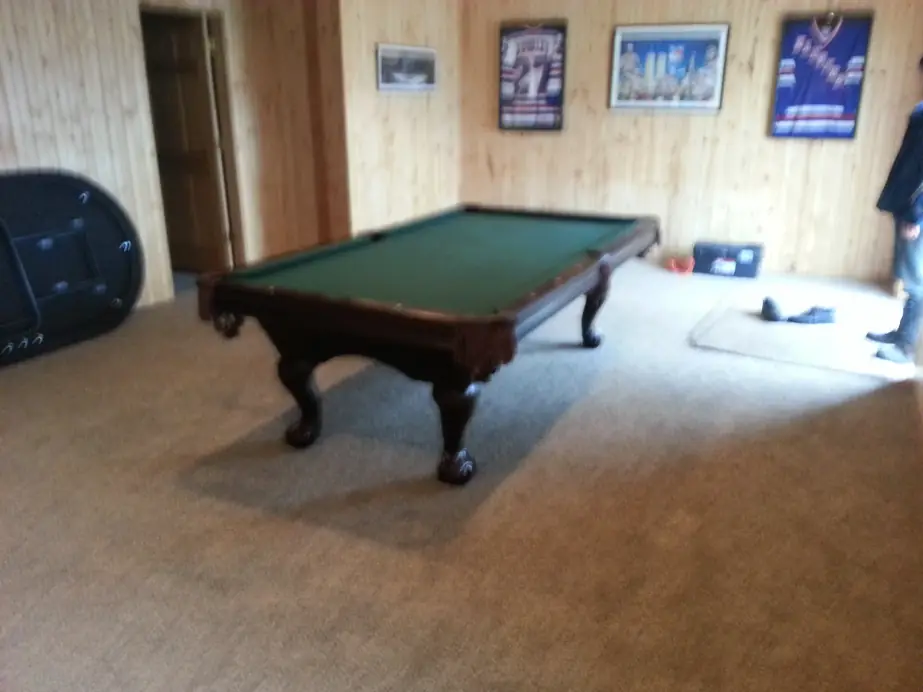
The table itself is the easy part of the measurement. A 7-foot table is 3'5" by 7', and an 8-foot table is 4' by 8'. What catches people out is everything around it. Every shot needs room for the cue to swing back and through, and that room has to exist on all four sides of the table, not only the side you like to shoot from.
Why the cue sets the room size
Think about where the back end of the cue goes on a shot from the rail. It points straight back toward the wall, or toward a door, a post, a staircase or a person on the sofa. If there is not enough clear floor, you end up shortening your stroke, switching to a shorter stick or giving up on certain shots. The length of the cue you play with is therefore the number that decides how big the room has to be.
That is why the shop's room chart gives three answers for every table size. The three columns are for a 48 inch cue, a 52 inch cue and a 58 inch cue, and 58 inches is the longest of the three. Choose the cue your household will actually use. If anyone in the house plays with the longest one, plan for the third column.
The room chart, size by size
These are the minimum room sizes from the chart, written as the two room dimensions for a 48 inch, a 52 inch and a 58 inch cue, in that order.
- 7-foot table: 11'6" x 14'6", then 12' x 15', then 13' x 16'.
- 8-foot table: 12' x 15'6", then 12'6" x 16', then 13'6" x 17'.
- 8-foot oversized table: 12'6" x 16'6", then 12'6" x 16', then 13'6" x 17'6".
- 9-foot table: 12'6" x 16'6", then 13' x 17', then 14' x 18'.
Treat these as minimums. A room that matches a number exactly will work, but it leaves no slack for a cue rack on the wall, a bench along one side or a person standing and waiting for a turn. If your room is close to a line on the chart, call the shop and talk it over before you order anything.
Measure the room the way a cue sees it
Measure wall to wall in both directions at about waist height, which is where a cue swings. The finished wall is what counts, so do not measure to a baseboard that sticks out a fraction. Then walk the room and look for anything that cuts into the space, and write down the smallest clear distance you find in each direction, not the biggest.
- Stair rails, support posts and half walls that stand inside the playing area.
- Doors that swing into the room and would be blocked by a player's stroke.
- A bar, sofa or built-in cabinet that stays where it is.
- A fireplace hearth or a heater that sticks out from the wall.
- Low beams, ducts and ceiling fans, which are easy to forget about.
Do not forget the ceiling
Ceiling height is the measurement people skip. Raising the back of the cue for a steep shot needs clearance above, and a hanging light that looks great over the table sits right in the swing path if it hangs too low. Measure the clear height under any fixture you plan to keep, and stand at the spot where the table will sit and make a few practice strokes with a real cue if you have one.
Getting the table into the room
A slate table is brought in as separate pieces and assembled in the room, so a tight staircase or a narrow doorway is not the barrier it would be for a finished piece of furniture. The pieces still need a clear path, and the crew needs room to work around the frame. At the shop, a new table installation covers installing the table, assembling the slate and sealing the seams, and installing the felt and leveling it. That all happens in the room you measured, which is one more reason to get the room numbers right first.
Basements and bonus rooms are popular spots for game tables, and they are also where posts, ducts and low beams tend to hide. A tape measure and ten minutes of walking around the room will save you from a surprise on delivery day.
The room size guide on this site shows the full chart in one place, and the Brunswick tables page lists the sizes the shop sells. If your room sits between two sizes, call Steve at (845) 597-5532 and describe the space.
Steve's Pool Tables Plus, (845) 597-5532
Call (845) 597-5532More articles
How to Tell When Your Pool Table Needs New Felt
Cloth wears out slowly enough that most owners stop noticing, so here is how to spot it and what happens when the table gets recovered.
Why a Slate Pool Table Has to Come Apart to Move
A slate table is a stack of carefully fitted parts, and moving it means taking it down and building it back up in the new room.